How Much Land Does Each Attraction Really Need?
Attractions don't scale the way most owners expect, so measure the ground before you fall for a layout.
October 21, 2026 · 4 min read
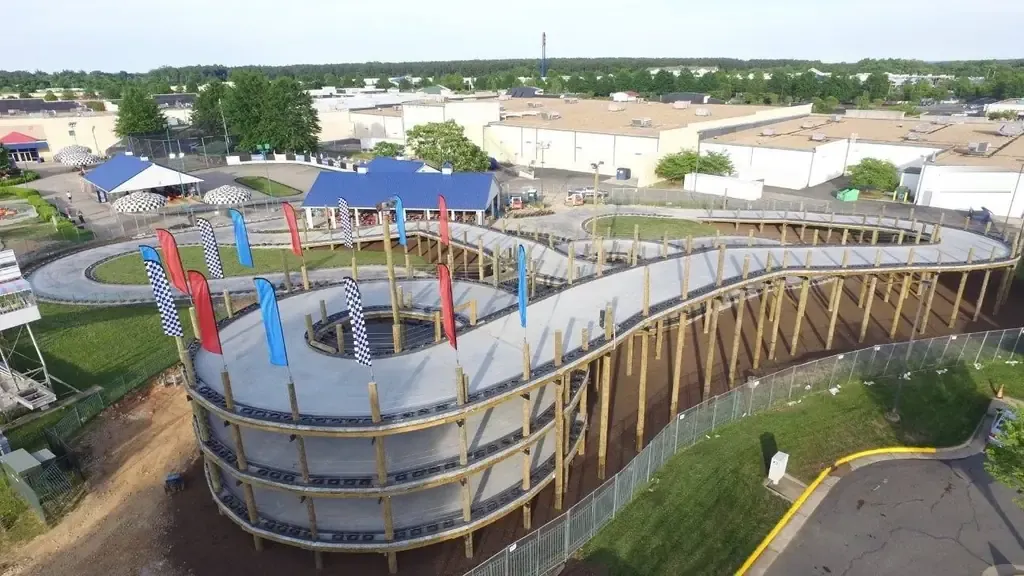
Walk a parcel with a tape measure and the question changes. It stops being what you want to build and becomes what the ground can hold. Attractions don't scale the way most people expect. A go-kart track wants about an acre, while a nine-stall batting cage fits on well under half of one. A full mini golf course can sit on a corner of a dairy bar lot.
MGC Developers, which has been designing and building family entertainment centers since 1989, publishes land figures for its main attractions on its FAQ and service pages. This article collects them in one place and adds some general planning notes on how to read them. Treat every number as a starting point. Drainage, setbacks, parking and the shape of your parcel will move the real answer.
Mini golf: smaller than most owners guess
MGC puts a typical miniature golf course at one half to three quarters of an acre, and says it can be built on as little as a quarter acre. The typical course MGC describes is not a bare-bones one. It has 18 holes, a practice putting green, sidewalks, lighting, multiple levels, rockwork, waterfalls, ponds and streams. MGC gives a build time of 6 to 12 weeks for that package.
The quarter acre end is a tighter design problem. Walks between holes get shorter, and features tend to stack upward instead of spreading out, which is one reason multi-level rockwork matters on small lots. If your parcel is tight, say so at the very start, because layout is where size gets won or lost.
Go-karts: the biggest ask on the list
For a 1,000 linear foot track, MGC says to plan on about one acre, or 45,000 square feet. It recommends a track length of 800 to 1,200 linear feet, with one kart for every 40 feet of track. Do the arithmetic and that range holds roughly 20 to 30 karts at a time. MGC's typical package, as it describes it, is 18 cars.
MGC lists a covered shade structure, lighting and a pit area as part of a go-kart track, so those belong in your footprint thinking from day one. Whether parking and walkways sit inside that acre or on top of it is worth asking early. MGC also describes tracks with interesting turns and multiple levels, indoors and outdoors, and stacking track on levels is one of the ways designers can get length out of limited ground.
Batting cages: a small footprint that grows fast
MGC builds batting cages in 4 to 9 stalls, with a baseball machine, a softball machine, or both. It gives a five-stall footprint of about 5,400 square feet, which is .13 of an acre, and a nine-stall footprint of about 17,230 square feet, or .41 of an acre.
Look at how those two numbers relate. Going from five stalls to nine is less than double the stalls, but the footprint more than triples. MGC notes that its radius style gives each stall a 90 degree hitting area. A fan shape like that probably explains why ground use climbs faster than stall count, so don't scale the small number up in a straight line. Ask for the area at your real stall count.
Bumper boats: the water is the footprint
MGC's rule of thumb is 250 square feet of pond per boat. A typical pond runs 3,600 to 5,000 square feet, and the FAQ range is 2,400 to 8,000. At 250 square feet a boat, a typical pond comes out to roughly 14 to 20 boats. Plan space around the water for a dock, a queue and any waterfall feature, because those sit beside the pond rather than in it.
The numbers on one page
- Mini golf: one half to three quarters of an acre typical, as little as a quarter acre.
- Go-kart track: about one acre (45,000 sq ft) for a 1,000 linear foot track, with 800 to 1,200 linear feet recommended.
- Batting cages: about 5,400 sq ft for 5 stalls and about 17,230 sq ft for 9 stalls.
- Bumper boat pond: 250 sq ft per boat, 2,400 to 8,000 sq ft overall, 3,600 to 5,000 typical.
Those are attraction footprints. Parking, restrooms, a counter or snack building and drainage all take ground too, and what your town requires for setbacks and site plans is a local question to settle early. MGC's About page lists site location and obtaining permits among the things it helps owners with, so bring the parcel into the conversation before you commit to buying it.
One more planning habit: if the parcel can hold more than your first attraction, draw the second one on the plan now, even if you won't build it for years. Leaving room on paper costs nothing, and it keeps a later addition from fighting your parking or your drainage.
If you have a parcel in mind, MGC's service pages lay out these figures in more detail. Start with /services/go-kart-tracks, since a track is the largest ask, and read the /faq for sizing and pricing. For a conversation about your site, call MGC at (860) 749-4434 or use /contact.
MGC Developers, (860) 749-4434
Call (860) 749-4434More articles
Concrete or Asphalt for a Go-Kart Track, and What a Tire-Backed Rail Does
Two choices shape how a go-kart track wears and protects riders: the surface under the karts and the wall beside them.
Where the Money Goes on a Mini Golf Course
Theming and rockwork move the number more than anything else, so know what a typical 18-hole build includes before you pick a theme.